
ST. CLOUD, Minn. — Cori Roberts was living in a rented basement four years ago when she was diagnosed with early-stage cervical cancer.
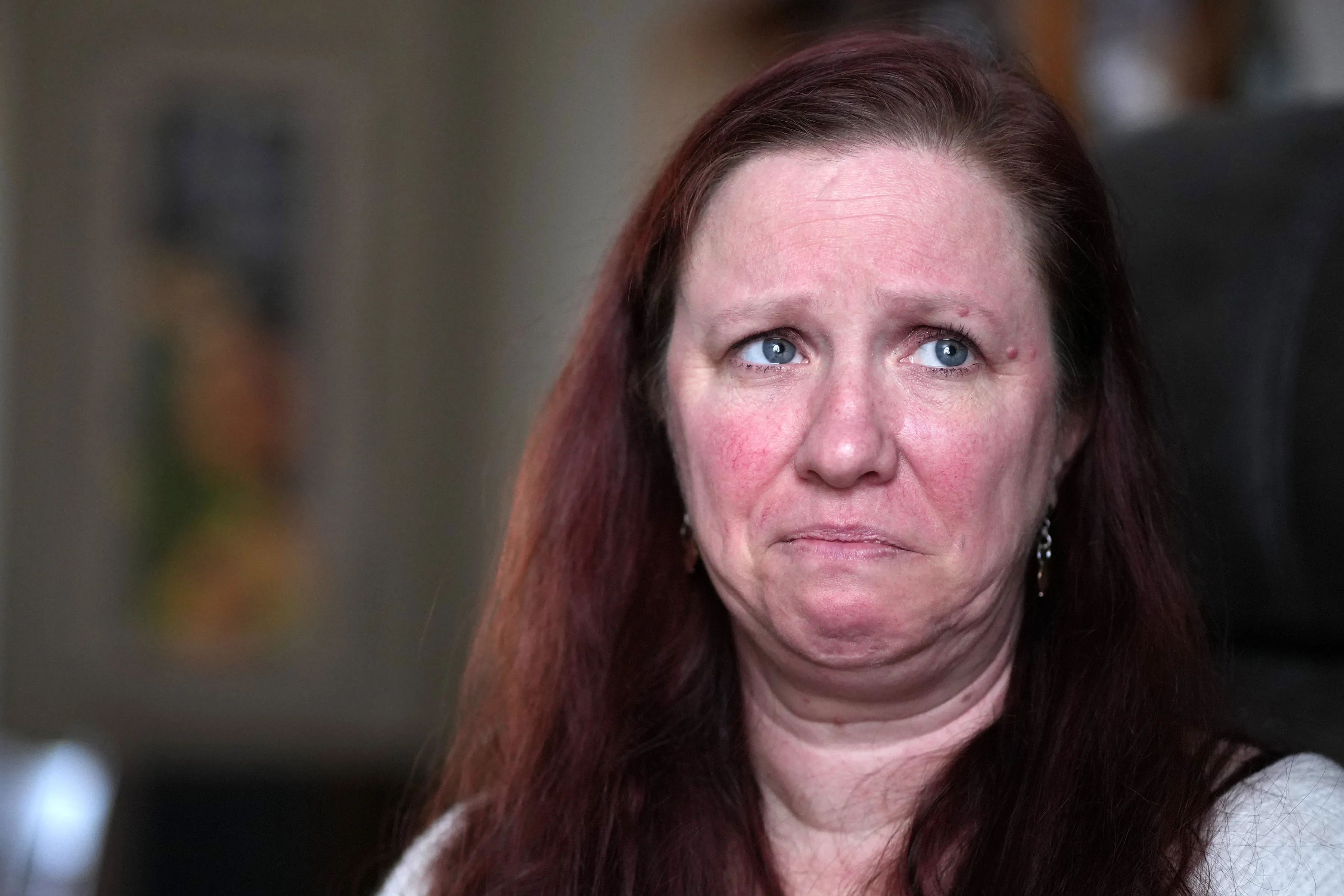
Cori Roberts spent years trying to pay off her medical debt to CentraCare after the health system told her she did not qualify for financial aid, she says. She ultimately paid more than $6,000, but the health system sued her over the balance. (Anthony Soufflé/The Minnesota Star Tribune)
Recently divorced, the former stay-at-home mother had started working again in her mid-40s, taking a human resources job that paid $41,000 a year. Then, despite having insurance, she was hit with more than $8,000 in medical bills.
“I had my car and a basket of clothes,” Roberts recalled. “Medical bills were not something I could have afforded.”
Roberts sought financial assistance from CentraCare, the St. Cloud-based health system that treated her. It’s a nonprofit charity that receives millions of dollars in federal, state, and local tax breaks. In exchange, it’s obliged to offer charity care to patients who can’t afford their medical bills. But Roberts said CentraCare told her she made too much to qualify.
Roberts instead scrimped on groceries and Christmas gifts for her kids and paid off more than $6,000 over two years. Then CentraCare sued her last year because she hadn’t paid off all the debt.
“They’re supposed to be a nonprofit,” Roberts said. “It’s like, ‘Come on!’”
CentraCare earmarks a tiny fraction of its budget for helping patients with medical bills they can’t pay, but it’s not alone, a Minnesota Star Tribune-KFF Health News investigation found.
Minnesota’s hospitals and health systems are among the least charitable in the country, the investigation found, providing less financial aid as a percentage of their operating budgets on average than hospitals in almost every other state, including Illinois, Iowa, Nevada, and Texas.
The investigation drew on a detailed review of every hospital charity care program in the state, an analysis of five years of hospital financial data, and dozens of interviews with patients, hospital executives, and state officials.
Nationally, hospitals spend an average of about 2.4% of their operating budgets on charity care, according to federal hospital data compiled by Hossein Zare, a researcher at Johns Hopkins University. Minnesota hospitals spend about a third of that, on average.
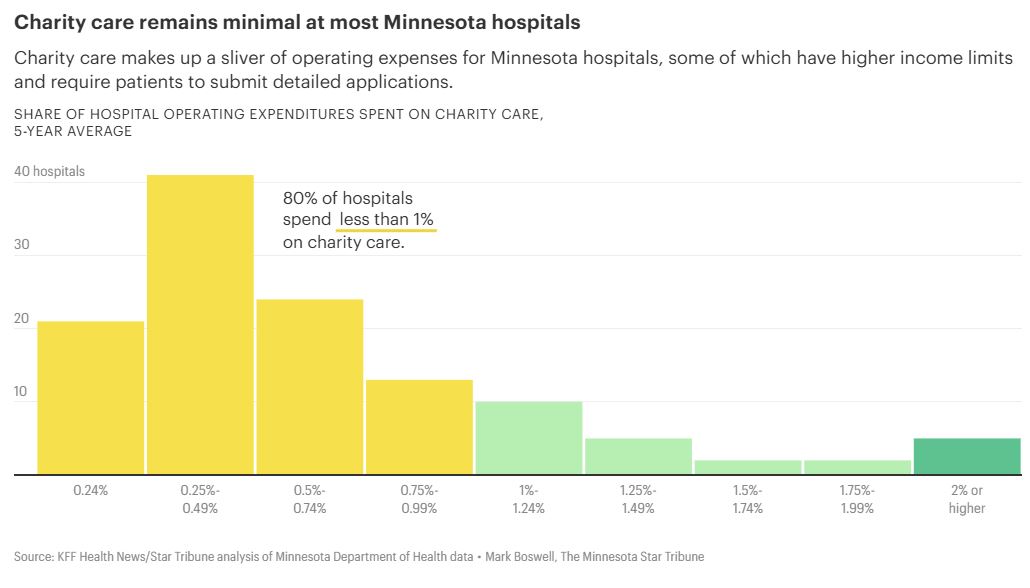
Some spend considerably less. Of Minnesota’s 123 general hospitals, 62 devoted less than 0.5% of their operating budgets to charity care from 2020 through 2024, the Star Tribune-KFF Health News investigation found.
“The system is not working,” said Erin Hartung, director of legal services at Cancer Legal Care, a Minnesota nonprofit that helps patients with medical debt and other financial challenges. “And the burden is falling hardest on the people who are least able to bear it.”
CentraCare’s flagship St. Cloud Hospital spent less than 0.25%, according to the analysis. That works out to $25 in patient aid for every $10,000 spent on hospital operations.
Charity care will become even more vital in coming years as Minnesotans lose health coverage or can’t afford rising copays and deductibles. The state's uninsured rate rose sharply last year, hitting its highest level since 2017, and it’s expected to increase further as budget cuts pushed by President Donald Trump force states to pare Medicaid and other safety net programs. Charity care is also critical to many people with health insurance who can’t afford their bills.
Hospital officials say it’s unfair to expect them to solve this affordability problem when many of their facilities are financially strained. “No amount of charity care from hospitals will ever fully meet the needs of uninsured or underinsured Minnesotans. The need is simply too great,” Minnesota Hospital Association spokesperson Tim Nelson said in a statement.
But state Attorney General Keith Ellison said hospitals have a duty to boost charitable help for all needy patients in exchange for the tax breaks they receive.
“There is a benefit you get from being a nonprofit hospital in the state of Minnesota,” he said. “But do the people get the benefit?”
Several small Minnesota hospitals give financial aid to fewer than two dozen patients a year. Mahnomen Health Center, which recently converted to a rural emergency center, didn’t provide any charity care in eight years, despite serving one of Minnesota’s most impoverished regions. Other hospitals serving large low-income populations were among those providing the least charity care, the analysis found.
Several factors help explain why Minnesota hospitals provide so little financial aid. For one, job-based insurance and an expanded Medicaid program offer broad coverage. Hospitals in states with less government assistance and more uninsured people typically spend more on charity care.
But Minnesota patients also face significant barriers accessing financial aid at many hospitals, including inconsistent eligibility standards and extensive applications, the Star Tribune-KFF Health News investigation found.
To qualify at many hospitals, patients must submit detailed personal information, including bank statements, retirement accounts, mortgage documents, and estimates of other assets such as cars, homes, or livestock.
And because Minnesota has not standardized the criteria for charity care, patients might receive aid at one hospital but not another. The investigation found that some hospitals give free care to patients with an annual household income of $47,000, while others cap it at about $15,000.
Had Roberts driven 30 miles east to Princeton or 35 miles north to Little Falls, she would have found medical providers with more generous financial aid policies than CentraCare. But she didn’t know to look.
Roberts, now 49, has remarried and lives in a split-level home in St. Cloud decorated with inspirational plaques such as “Faith, Family, Friends.” CentraCare recently dropped the lawsuit against her, but only after she took out a loan against her retirement plan to pay off the medical debt. “It just feels very unfair,” she said.
Comments