
Key Points
-
The Constitution gives authority to state and local governments, not the federal government, to set school vaccine requirements and currently all 50 states and DC currently require certain vaccines for school attendance. All jurisdictions require MMR, DTaP, polio, and varicella vaccination for school-age children, while requirements for several other vaccines vary by state. All states allow for exemptions to these requirements.
- Jurisdictions differ substantially in how they allow parents to claim exemptions from school vaccine requirements. All states permit medical exemptions, while 45 states and DC permit religious and/or personal belief exemptions. States also vary widely in the documentation, review, and other requirements for obtaining an exemption.
- Due to actions by the Trump administration, which has questioned the safety and effectiveness of vaccines and sought to reduce the number of recommended childhood vaccines, a growing number of states has begun to delink their recommendations from those of the federal government, which may have implications for school vaccine requirements. As of August 2026, 30 states and DC had announced that they would no longer follow Centers for Disease Control and Prevention’s (CDC) Advisory Committee for Immunization Practices (ACIP) recommendations for one or more childhood vaccines, with 27 states delinking from CDC/ACIP recommendations for all childhood vaccines. Because state and local school vaccination policies may be linked to states’ broader childhood vaccine recommendation policies, these moves could have implications for school entry requirements.
- Recent state policy changes have generally made non-medical exemptions easier to obtain. Since 2025, at least nine states have enacted changes that make non-medical exemptions more permissive, including by reducing documentation or procedural requirements. Research indicates that easier-to-obtain non-medical exemptions are associated with higher exemption rates and, in turn, declining childhood vaccination coverage.
These trends are taking place in the context of falling national childhood vaccination rates since 2019, declines that are entirely attributable to the growth in non-medical exemptions. Higher exemption rates have been associated with increased incidence of diseases such as measles and pertussis, indicating continued outbreaks that place more children at risk for vaccine-preventable diseases in the U.S. are likely.
Evolution of School Vaccine Requirements
Under the U.S. Constitution, states (and local governments) have the authority to impose immunization requirements, not the federal government (see Box 1). The earliest known school vaccine requirements in the U.S. were put in place by a local government in the 19th century, when Boston enacted a city-wide requirement for smallpox immunization for school entry in 1827. In 1855, Massachusetts enacted the first state-level school vaccine mandate, also for smallpox. As more childhood vaccines were developed and recommended for routine use over time, states began adding additional requirements for diphtheria, tetanus, pertussis, and polio. By 1963, 20 states required at least one vaccine for children to attend school.
Box 1: Legal Powers of States and the Federal Government Relating to Vaccine Requirements
The U.S. Constitution provides certain public health powers to states and to the federal government. The 10th Amendment “police powers” clause grants states the responsibility for enacting laws to promote health, safety and general welfare (such as public health), which has come to be interpreted as including the power to enact vaccine requirements. . The Constitution grants the federal government public health responsibilities relating to inter-state and border disease control, and tax and spending powers that allow the government to direct funds to states for specific purposes such as vaccinations. In addition, the federal government has licensing and regulatory oversight of vaccines through Department of Health and Human Services (HHS) agencies such as the Food and Drug Administration (FDA) and Centers for Disease Control and Prevention (CDC).
Over time there have been legal challenges to states’ powers to impose school vaccine requirements, but the federal courts have consistently ruled in favor of states’ powers. For example, in the Jacobson vs. Massachusetts (1905) ruling, the Supreme Court established that states can mandate vaccines for school attendance and impose fines for non-compliance; Zucht vs. King (1922) affirmed that schools can require proof of vaccination prior to entry; and Prince vs. Massachusetts (1944) upheld states power to impose vaccination mandates despite parental objections based on religious beliefs. As recently as 2026, a federal appeals court affirmed New York state’s 2019 repeal of its prior “religious beliefs” exemption for school vaccine mandates that had been enacted after a large measles outbreak in the state, rejecting a challenge to the law brought by Amish parents (Miller vs. McDonald, 2026).”
In the 1960s, the federal government also increased its support to states for vaccinations and broadened its immunization-related policy-making efforts. In 1962, Congress created the Public Health Service Section 317 Immunization Grants Program, which allowed federal funds to be directed to state and local jurisdictions for purchasing vaccines. In 1964, a new specialized expert committee called the Advisory Committee on Immunization Practices (ACIP) was established at the federal level to provide guidance regarding vaccines. ACIP was designated an official federal advisory committee and placed organizationally under the Centers for Disease Control and Prevention (CDC) Director in 1972. The 1960s and 1970s also saw the licensure of new combination measles, mumps and rubella (MMR) vaccines, coinciding with a number of measles outbreaks among children that drew national attention, and spurred expanded federal and state efforts to strengthen and update vaccination laws (the measles vaccine was added to the federal 317 program in 1965). In the 1970s, large measles outbreaks in Alaska (1976) and Los Angeles, California (1977) led policymakers in those states to enact stricter measles vaccination requirements for school children that resulted in lower measles incidence, demonstrating to policymakers nationwide that enforcement of immunization requirements was possible, acceptable, and effective for most communities. Subsequently, CDC encouraged all states to implement school immunization requirements.
By 1981, all 50 states and DC had some form of school immunization requirements, and in the 1981-82 school year, vaccination levels in school entrants nationwide had reached 96% or higher for diphtheria-tetanus-pertussis (DTP), polio, and measles vaccines. In 1983, CDC/ACIP published the first general federal recommendations for childhood vaccinations, which were updated in 1989 and eventually merged with the recommended schedule issued by the American Academy of Pediatrics (AAP) in 1995. Throughout the 1990s and 2000s more vaccines were added to the CDC/ACIP recommendations for children and adolescents, including Hepatitis A, Hepatitis B, Haemophilus influenzae type b (Hib), pneumococcal, rotavirus, varicella, human papillomavirus (HPV), and meningococcal vaccines. Over time, states have integrated many of these vaccines into their school immunization policies as well, though the specific set of required vaccines varies across states, as described below.
Current state policies on school vaccination requirements
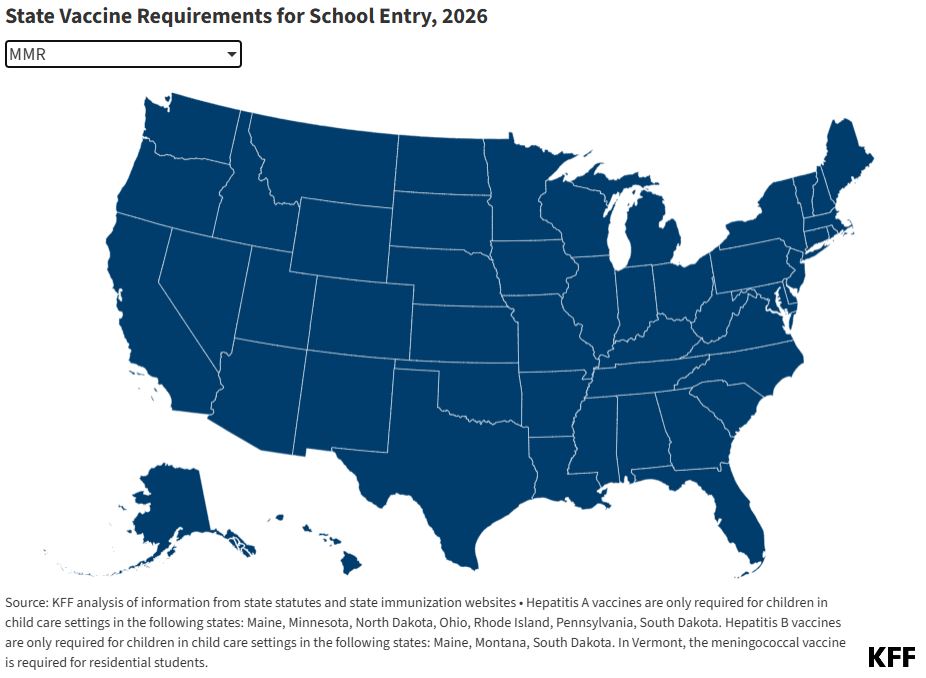
As shown in Figure 1, all 50 states and DC require MMR, DTaP, polio, and varicella vaccines for school-age children. Forty-nine states and DC also require Hepatitis B (Alabama is the exception), with three of those states requiring Hepatitis B for childcare settings only (Maine, Montana, South Dakota). Thirty-five states require meningococcal vaccines for school-age children, while 27 states require Hepatitis A. Just four jurisdictions require HPV vaccines for school-age children (DC, Hawaii, Rhode Island, and Virginia).
State Exemption Policies for School Vaccine Requirements
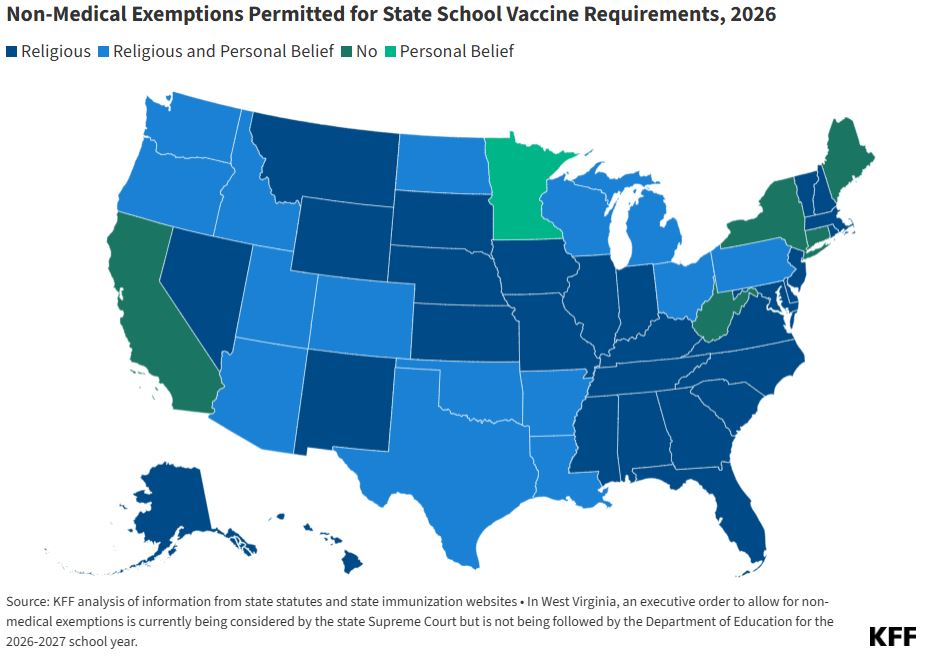
While all states allow for individual exemptions to state school vaccination requirements, the extent of these exemptions vary. They fall into two general categories: “medical” (exemptions based on medical contraindications) and “nonmedical” (exemptions based on religious beliefs or other personal/philosophical beliefs). Currently, all states allow for medical exemptions, while 45 states and DC allow for religious and/or personal belief exemptions (the exceptions are California, Connecticut, Maine, New York, and West Virginia). Of the jurisdictions allowing non-medical exemptions (see Figure 2):
- 30 states allow religious exemptions only
- 15 states allow religious and personal belief exemptions
- 1 state (Minnesota) allows personal belief exemptions only
Comments