
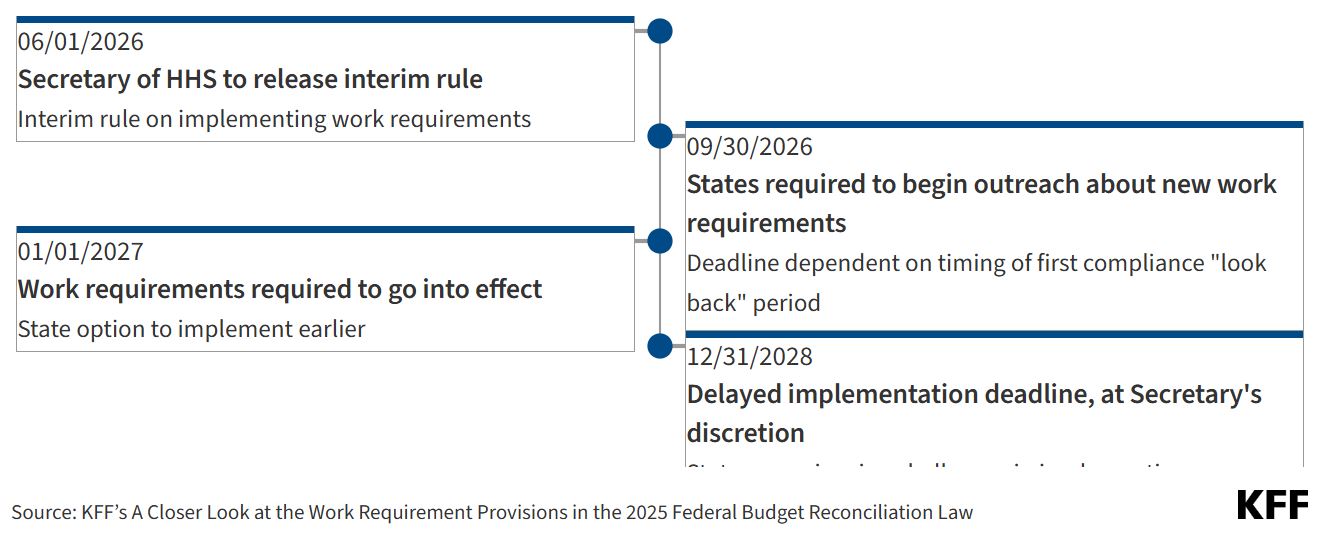
The 2025 reconciliation law, once called the “One Big Beautiful Bill,” signed by President Trump on July 4, 2025, conditions Medicaid eligibility for adults in the Affordable Care Act (ACA) Medicaid expansion group and enrollees in partial expansion waiver programs (Georgia and Wisconsin) on meeting work requirements starting January 1, 2027. Currently, 41 states (including DC) have expanded their Medicaid programs under the ACA to nearly all adults with income up to 138% FPL ($21,597 for an individual in 2025).
To implement Medicaid work requirements, states will need to make important policy and operational decisions, implement needed system upgrades or changes, develop new outreach and education strategies, and hire and train staff, all within a relatively short timeframe. The information tracked here can serve as a resource to understand Medicaid work requirements and state options, gauge readiness, and track implementation of the requirements, including:
- NEW: State reported plans and policies related to implementing Medicaid work requirements and county-level unemployment rate data, as well as state and national data on Medicaid enrollment, renewal outcomes, and application processing times;
- Federal guidance and a list of policy and operational questions that states will need to answer as they implement work requirements;
- Updates on 1115 waivers submitted by states to implement work requirements (while waivers will no longer be needed starting January 2027, some states may pursue waivers to implement work requirements earlier than January 2027); and
- A compilation of KFF issue briefs and other resources on Medicaid work requirements.
This resource will be updated to include guidance from the Centers for Medicare and Medicaid Services (CMS), information on state policy decisions as they are made, and new data when available.
Continue scrolling to learn more about the Medicaid work requirements in the 2025 reconciliation law.
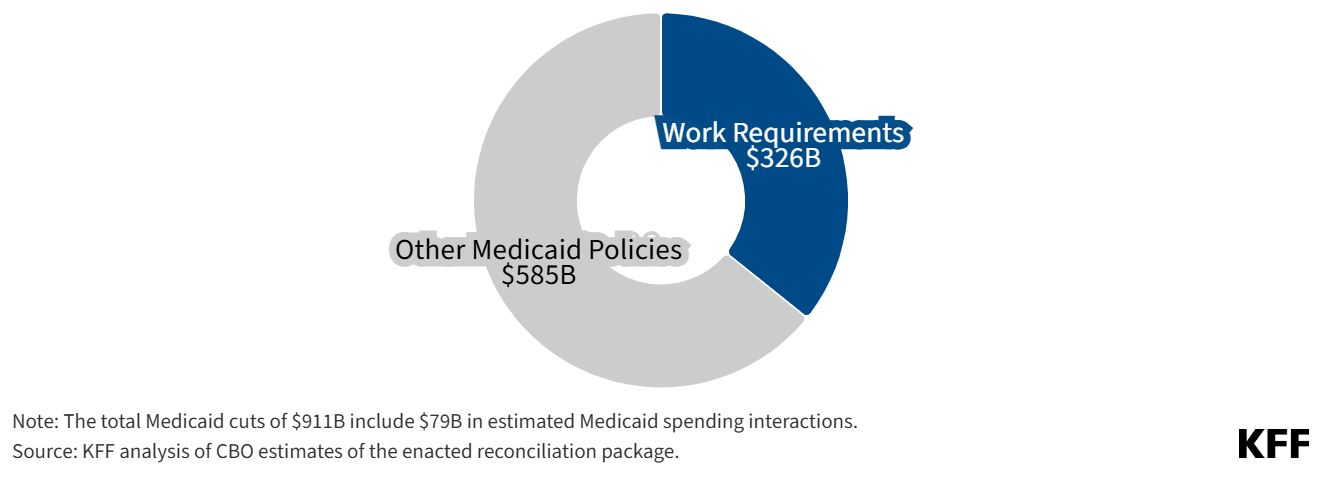
Work Requirements Are Estimated To Reduce Federal Medicaid Spending by $326 Billion Over Ten Years
CBO estimates of 10-year federal spending cuts in the 2025 reconciliation law.
Individuals Ages 19-64 Applying for Coverage or Enrolled Through the ACA Expansion Group Must Meet Work Requirements To Qualify for Medicaid
Qualifying Activities
• Enrolled in education at least half of time
• Any combination of minimum wage multipled by 80 hours
• Seasonal workers with an average monthly income over 6 months of minimum wage multiplied by 80 hours
Certain Individuals Are Exempt From the Requirements
Mandatory Exemptions
• Pregnant or receiving postpartum coverage
• Foster youth/former foster youth under age 26
• Medically frail
• Participating in SUD program
• Meeting SNAP/TANF work requirements
• American Indians and Alaska Natives
• Disabled Veterans
• Incarcerated or released from incarceration within 90 days
• Entitled to Medicare Part A/enrolled in Medicare Part B
States May Request Optional Hardship Exceptions
Optional Hardship Exceptions
• was in an inpatient hospital, nursing facility, intermediate care facility, or inpatient psychiatric hospital
• resided in a county with a federally-declared emergency or disaster
• resided in a county with a high unemployment rate (above 8% or 1.5x the national unemployment rate)
• traveled outside of the individual’s community for an extended period for medical care for themselves or for their dependent
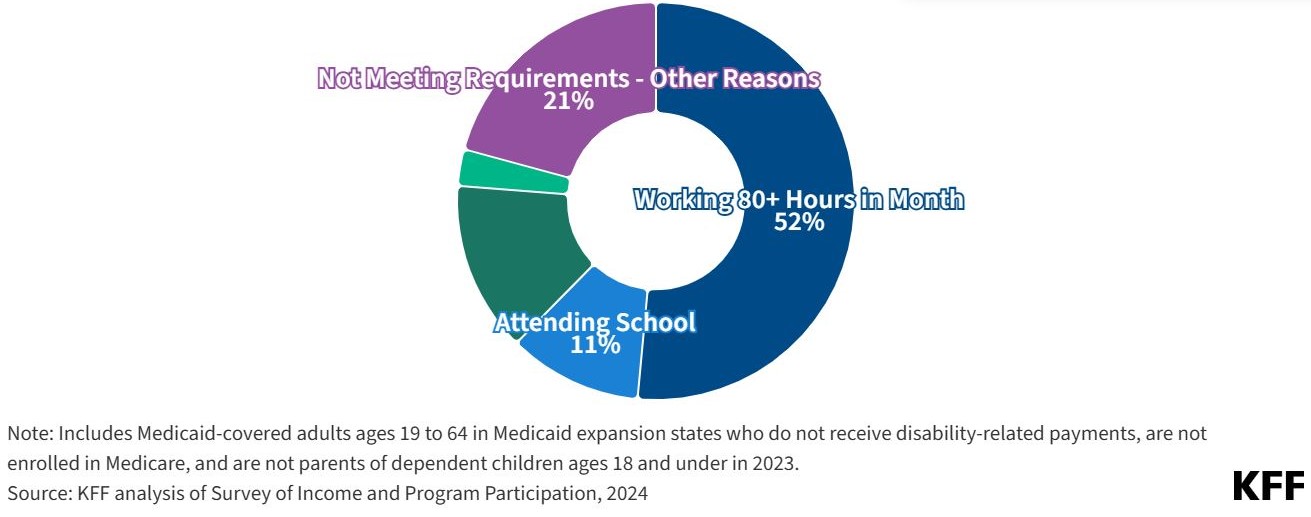
Most Medicaid Adults Without Dependent Children Subject to New Work Requirements Are Already Working or Would Likely Qualify for an Exemption
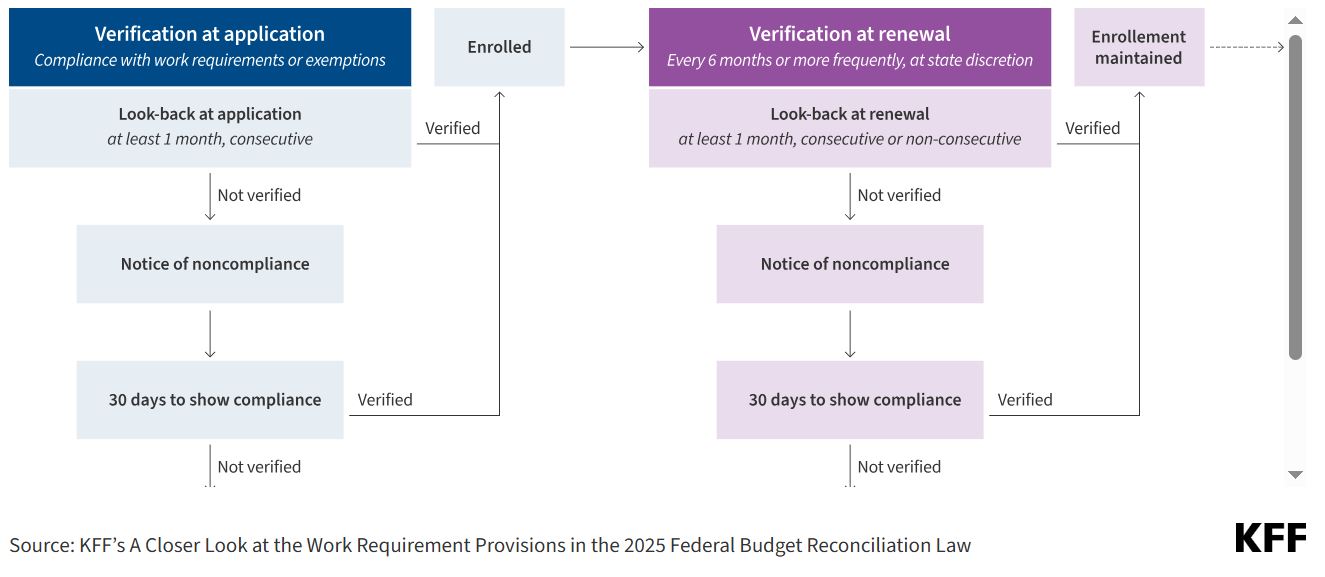
States Will Need To Verify Compliance With Requirements at Application and Renewal
States Are Required To Implement Work Requirements by January 2027
Inability To Meet Work or Reporting Requirements Could Lead to Loss of Medicaid Coverage
Hypothetical situation 1
• In June, he worked 80 hours in a new job.
• In July, he applies for Medicaid but his state uses a 3-month look-back period to verify compliance.
• John would not qualify for Medicaid, as he was out of work in two of the past three months.
Hypothetical situation 2
• She intermittently experiences severe episodes that make daily tasks difficult. Medication generally helps manage her depression and maintain employment.
• In May, Jane experienced a depressive episode that left her unable to meet the 80 hours of work.
• On June 1st, when Jane’s Medicaid renewal and verification of work compliance were due, she was deemed noncompliant and lost coverage.
• Without coverage, Jane is unable to access medication and treatment services, resulting in a worsening of her mental health condition.
In KFF Focus Groups, Medicaid Enrollees Said They Wanted To Work or Work More Hours but Were Unable To Due to Barriers
Click each box to start or pause the audio.
“I do self work with Instacart because …I get to pick and choose the days I’m able to work and dealing with my dad, getting in that nursing home and also dealing with my mom now because she’s getting into that phase where she’s needing more doctor appointments.”
52-year-old man
“When I was younger I used to work in warehouses and stuff and it just got to the point to where I couldn't do it anymore physically. Going to something where I can be more in a office space, taking care of copy machines and whatnot, it's a lot easier. it doesn't pay the greatest, but you know, it's part-time and, that's it, you know, really, [I] just need the money. "
45-year-old man
“Ever since I haven’t been working, I haven’t been able to find a job that’s legal or decent enough for working from home…They all want somebody in the office to stand up or sit down for long periods of time. I can’t even walk to my vehicle without being in pain. Or get into a vehicle and drive that vehicle because of the stress all behind that.”
51-year-old woman
Comments